



Science: The Art of Asking Better Questions
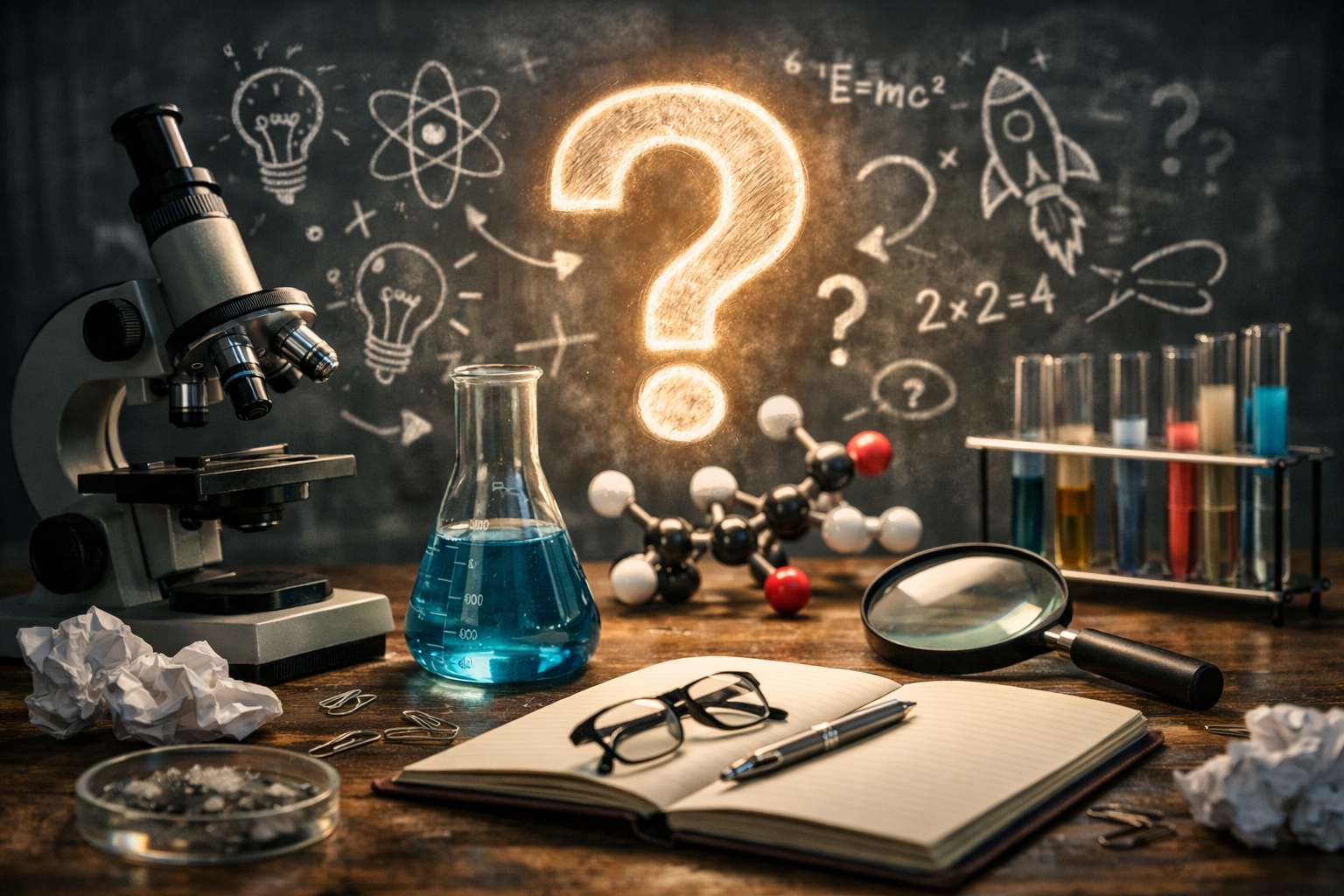
What Science Really Is
Science is often mistaken for a collection of facts—a catalog of what humanity “knows.” In reality, science is a method for producing dependable knowledge. It is a structured way of asking questions about the world, proposing explanations, and then stress-testing those explanations with evidence. Scientific conclusions are rarely treated as final; they are considered the best available descriptions or models given current data, always open to refinement when new observations arrive.
At its core, science balances imagination and skepticism. Researchers must be creative enough to propose hypotheses and design clever tests, but rigorous enough to challenge their own assumptions and accept results even when they conflict with expectations.
How the Scientific Process Works
The scientific process is not a single rigid checklist, but it does share recurring elements. Whether studying galaxies, ecosystems, or human behavior, scientists typically move through cycles of inquiry that emphasize transparency and reproducibility.
- Observation: Noticing a pattern or problem (e.g., a disease spreading, a material failing, a star behaving oddly).
- Question: Defining what needs explanation and narrowing it into something measurable.
- Hypothesis: Proposing a testable explanation that makes clear predictions.
- Experiment or Study: Gathering data through controlled experiments, fieldwork, surveys, simulations, or archival analysis.
- Analysis: Using statistics, modeling, or comparative methods to evaluate whether the evidence supports the hypothesis.
- Peer Review and Replication: Sharing methods and results so others can critique, reproduce, or extend the work.
Importantly, “negative results” can be as valuable as positive ones. If a prediction fails, scientists learn constraints on what could be true, and theories evolve accordingly. This is a feature, not a flaw: progress often comes from discovering where an idea breaks.
The Role of Measurement and Uncertainty
Scientific claims are strengthened by precise measurement. Yet measurement always carries uncertainty—instrument limits, sampling variation, and hidden biases. Rather than ignoring uncertainty, science attempts to quantify it. Confidence intervals, error bars, sensitivity analyses, and robustness checks are tools that help distinguish genuine effects from noise.
Why Science Changes Its Mind
People sometimes distrust science because scientific recommendations can change—dietary advice shifts, medical guidelines update, or climate projections refine. But revision is exactly what you should expect from an evidence-driven system. When better instruments, larger datasets, or improved methods become available, earlier conclusions may be adjusted. Science is not a promise of certainty; it is a commitment to self-correction.
Consider how models work: a model is a simplified representation of reality designed for prediction and explanation. Models improve when they are confronted with new data. In this way, scientific “truth” is often best understood as increasing accuracy and usefulness, not permanent finality.
Major Branches of Science—and How They Connect
Science is commonly divided into broad areas, but the borders are porous. Many of today’s most productive fields are interdisciplinary, blending methods and insights across domains.
- Physical Sciences: Physics and chemistry explore matter, energy, and fundamental interactions, from subatomic particles to planetary systems.
- Life Sciences: Biology studies living systems—genes, cells, organisms, and ecosystems—often relying on chemistry and physics to explain mechanisms.
- Earth and Environmental Sciences: Geology, meteorology, and ecology investigate the planet’s systems and how they interact with life and human activity.
- Social and Behavioral Sciences: Psychology, sociology, economics, and related fields examine human behavior and societies, often using statistical inference and experimental design.
- Computer and Data Sciences: These fields build tools for computation, simulation, and analysis that increasingly underpin research everywhere else.
For example, understanding a pandemic draws on virology (life science), aerosol physics (physical science), public health and behavior (social science), and data modeling (computational science). The power of science grows when these perspectives inform one another.
Science in Everyday Life
Even when you are not in a lab, you benefit from scientific thinking and scientific outputs. Modern sanitation systems reflect microbiology and chemistry; navigation relies on physics and satellite engineering; smartphones combine materials science, computer science, and cognitive psychology (for user experience). The same mindset—test assumptions, seek evidence, update beliefs—also improves daily decision-making.
Scientific literacy does not require memorizing formulas. It means recognizing what counts as good evidence, understanding the difference between correlation and causation, and knowing how to evaluate sources.
Common Misconceptions
- “A theory is just a guess.” In science, a theory is a well-supported explanatory framework (like evolution or germ theory), not a casual hunch.
- “One study proves it.” Reliable knowledge typically comes from multiple studies, replication, and converging lines of evidence.
- “Science is purely objective.” Science strives for objectivity through methods and norms, but scientists are human. This is why transparency, preregistration, data sharing, and peer critique matter.
The Ethical Side of Discovery
Because science can reshape societies, ethics are inseparable from research. Questions include: Who benefits from an innovation? Who bears risks? How is consent obtained? How are animals treated? How should data privacy be protected? Ethical review boards, regulations, and professional norms aim to keep discovery aligned with human rights and public well-being.
Equally important is the responsible communication of results. Overstating certainty, ignoring limitations, or cherry-picking outcomes can mislead the public and erode trust. Good scientific communication includes context: sample size, uncertainty, potential confounding factors, and what remains unknown.
The Future of Science: Faster, More Open, More Collaborative
Science is accelerating through improved instruments, global collaboration, and new analytical techniques. Artificial intelligence helps identify patterns in massive datasets, while automation speeds experimentation. Open science practices—preprints, open-access publishing, and shared code—aim to make research more transparent and reusable. At the same time, these changes introduce new challenges, such as ensuring quality control, avoiding algorithmic bias, and supporting equitable access to knowledge.
Ultimately, the enduring value of science lies in its attitude: curiosity paired with disciplined doubt. It teaches that understanding is earned through evidence, that claims should be testable, and that changing one’s mind in response to data is not weakness but wisdom.
Listings related to article "Science: The Art of Asking Better Questions"
Aver Conferences
Aver Conferences specializes in the coordination of scientific and international conferences across a diverse range of fields, including Science and Technology, Health and Medicine, Engineering, and Pharma subjects.
- Category
- Science » Events » Conferences

Art Kitchen Direct for Chicago Builders and Developers
Introducing Kinzini, the go-to destination for comprehensive kitchen services tailored exclusively for builders and developers in Chicago. With a meticulous approach from start to finish, they specialize in crafting exceptional kitchens, vanities, and closets that surpass industry standards.
- Category
- Home » Home Improvement » Kitchens
More articles like "Science: The Art of Asking Better Questions"

Reference Guide to World Records: How Extraordinary Feats Are Measured and Remembered
World records capture the outer limits of human achievement, natural extremes, and cultural curiosity. This guide explains what world records are, how they are verified, and why they remain a powerful form of global reference.

Science: The Art of Asking Better Questions
Science is a systematic way to build reliable knowledge by testing ideas against evidence. It thrives on curiosity, measurement, and a willingness to revise what we think we know.
Science: The Ever-Improving Toolkit for Understanding Reality
Science is a method for building reliable knowledge through testable ideas, careful measurement, and continual revision. Its power lies less in delivering final answers and more in refining models of the world that enable prediction, explanation, and innovation.