



Reference Guide to Knots: Essential Types, Uses, and Practical Selection Tips
Understanding Knots as Practical Tools
Knots are more than simple rope twists; they are functional structures designed to solve specific problems. A well-chosen knot can secure a load, join two lines, create a loop, add friction for control, or release quickly when needed. Across sailing, climbing, camping, fishing, rescue work, and household tasks, the effectiveness of a knot depends on how it matches the rope material, the direction of load, and the need for strength, adjustability, or easy untying.
A reference to knots is useful because no single knot fits every purpose. Some knots are prized for security, others for speed, and some for the ability to hold under strain without permanently jamming. Understanding the main families of knots makes it easier to recognize which option is appropriate in real-world use.
Main Categories of Knots
Stopper Knots
Stopper knots are tied at the end of a rope to prevent it from slipping through a hole, pulley, cleat, or another knot. They can also reduce fraying and make rope ends easier to handle. Common examples include the overhand knot, figure-eight knot, and double overhand knot. The figure-eight is especially popular because it is easy to inspect and generally less likely to jam than a simple overhand.
Loop Knots
Loop knots create a fixed or adjustable loop in a rope. A fixed loop holds its size under load, while an adjustable loop can be resized. The bowline is one of the best-known fixed loop knots because it forms a dependable loop that is relatively easy to untie after loading. The figure-eight on a bight is another trusted loop, especially where security and visual inspection matter. Adjustable loops, such as the taut-line hitch when used in tensioning, are useful for guy lines and temporary setups.
Bends
Bends are knots used to join two ropes together. They are especially valuable when ropes differ in diameter, texture, or stiffness. The sheet bend is a classic choice for joining dissimilar lines, while the double sheet bend provides more security. The double fisherman’s bend is often used when a very secure join is needed, though it can be difficult to untie after heavy strain.
Hitches
Hitches attach a rope to an object such as a post, ring, rail, or carabiner. Their performance depends heavily on constant tension, direction of pull, and surface friction. The clove hitch is fast and convenient for temporary attachment, but it may shift if the load changes. The round turn and two half hitches offers greater stability for general fastening. The timber hitch is useful for dragging or lifting long cylindrical objects, and the rolling hitch is designed to grip another rope or spar.
Binding and Friction Knots
Binding knots hold objects together, such as bundles, packages, or compressible materials. The reef knot, also called the square knot, is widely known, though it is best used for binding rather than for critical load-bearing applications. Friction knots, by contrast, grip a rope when weighted and slide when released. Knots such as the Prusik and Klemheist are important in climbing and rescue systems because they can function as progress-capture or backup elements.
Important Characteristics of a Good Knot
When evaluating knots, users usually consider a few key characteristics. Security is the knot’s ability to remain tied under expected loads and movement. Strength refers to how much the knot reduces the rope’s original breaking strength; all knots weaken rope to some extent because they create bends and compression points. Ease of tying matters in poor weather, low light, or emergency conditions. Ease of inspection is also important, especially in safety-critical settings where mistakes must be detected quickly. Finally, ease of untying can be crucial when a knot has been heavily loaded but still needs to be removed without cutting the rope.
Security: Resists slipping or capsizing under load.
Strength retention: Minimizes rope weakening.
Stability: Holds shape despite movement or variable pull.
Untiability: Can be released after loading.
Speed: Quick to tie and quick to verify.
Common Reference Knots and Their Uses
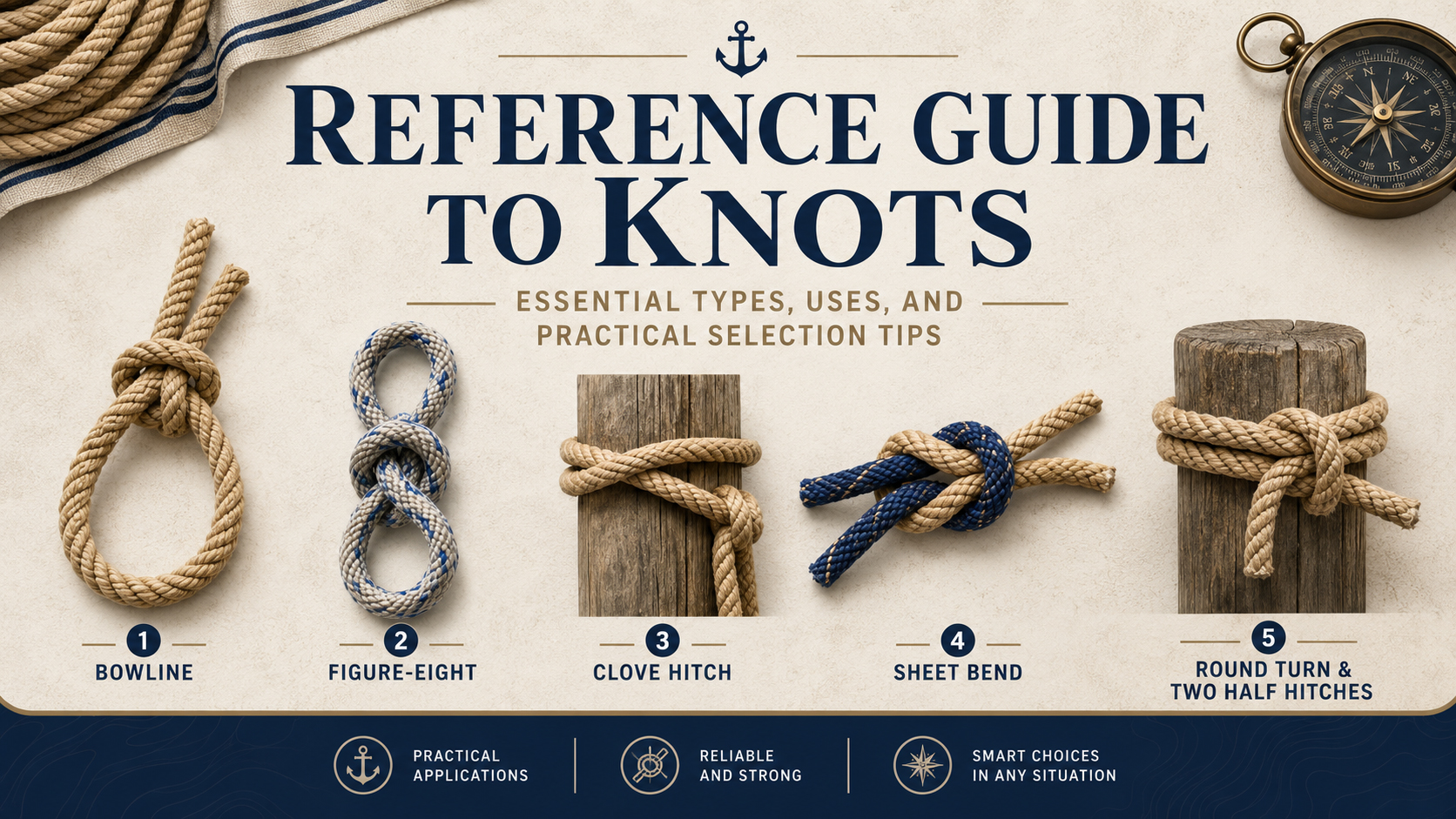
Bowline
Used to create a fixed loop at the end of a rope. It is common in boating, rescue, and general utility tasks. It is valued for easy untying, but it should be tied correctly and, in some cases, backed up for added security.
Figure-Eight Knot and Figure-Eight Loop
The basic figure-eight is often used as a stopper knot. Variations that create loops are favored where a clear, inspectable structure is needed. They are widely recognized in climbing and rigging contexts.
Clove Hitch
Useful for quick attachment to a pole or carabiner. It is fast and adjustable, making it practical for temporary positioning, though it should not be chosen blindly for dynamic or shifting loads.
Sheet Bend
A practical bend for joining two ropes, especially when they are unequal in size. It is a staple reference knot because of its versatility and relatively simple structure.
Round Turn and Two Half Hitches
Well suited for fastening a rope to a post or ring where the load will remain steady. The initial round turn adds friction, helping control strain before the hitches are finished.
How to Choose the Right Knot
The right knot depends on the job. If you need a permanent-looking loop that can still be untied, a bowline may be appropriate. If clear inspection and structure matter more, a figure-eight loop may be a better choice. For joining ropes, consider whether the lines are the same size and whether the connection will be heavily loaded. For attaching rope to an object, think about whether the load is static, intermittent, or likely to shift direction.
Rope material also changes performance. Modern synthetic ropes can be slicker than natural fiber ropes, which means some traditional knots may slip more easily unless dressed and set carefully. Wet conditions, vibration, and repeated loading can also affect knot behavior. For that reason, practical testing and training are as important as memorizing names.
Best Practices for Knot Use
Dress the knot neatly so all parts lie in their intended positions.
Set the knot firmly before trusting it with significant load.
Leave adequate tail length where appropriate.
Inspect knots visually and by feel before use.
Match the knot to the rope type and application.
Do not rely on decorative or binding knots for life-safety tasks unless specifically intended for that purpose.
Conclusion
A solid reference for knots begins with understanding function rather than memorization alone. Stopper knots prevent slippage, loop knots create attachment points, bends join ropes, hitches secure rope to objects, and friction knots add controlled grip. By learning the strengths, limits, and typical uses of core knots such as the bowline, figure-eight, clove hitch, sheet bend, and round turn with two half hitches, anyone can make better, safer, and more efficient choices when working with rope.
More articles like "Reference Guide to Knots: Essential Types, Uses, and Practical Selection Tips"

Reference Thesauri: How Structured Vocabularies Improve Discovery and Meaning
Reference thesauri are controlled vocabularies that organize related terms to improve indexing, searching, and knowledge discovery. They help users move beyond simple synonyms by showing broader, narrower, and associated concepts in a structured way.

The Power of Reference: How Reliable Anchors Shape Knowledge and Trust
A reference is more than a citation—it is a structured link to prior knowledge that enables verification, context, and credibility. This article explains what references are, why they matter, and how to use them effectively across academic, professional, and digital settings.

The Power of Reference: How Trustworthy Pointers Shape Knowledge, Design, and Decisions
A reference is more than a citation—it’s a reliable pointer that connects people, systems, and ideas to verifiable sources. This article explains references across writing, research, software, and everyday decision-making, with practical guidance for using them well.