



The Living Language of Arts: How Humans Shape Meaning Through Making
What We Mean by “the Arts”
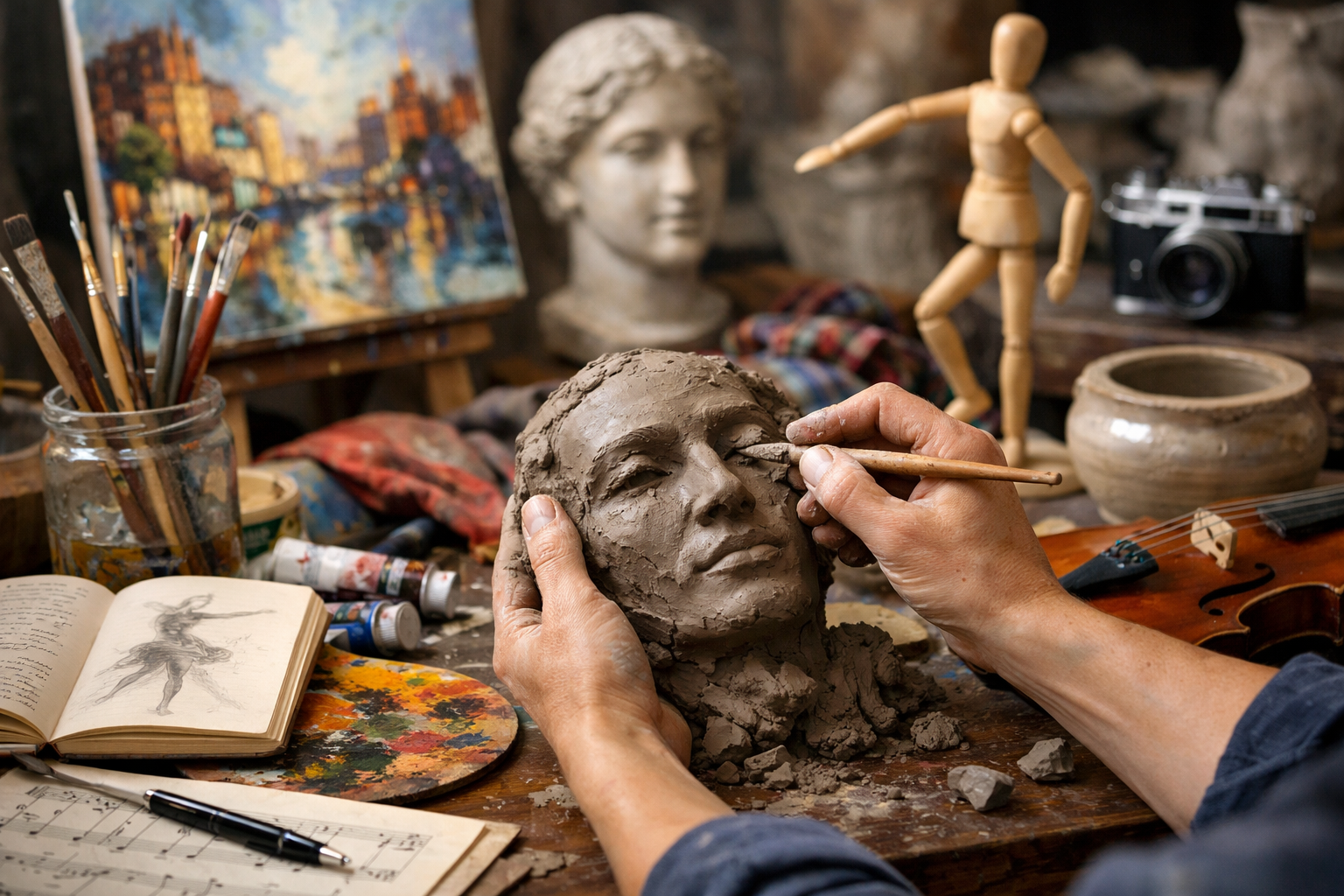
The arts are the many ways people transform imagination, skill, and material into experiences that communicate meaning. They include forms we often group as visual arts (painting, sculpture, photography, design), performing arts (music, dance, theatre), literary arts (poetry, fiction, spoken word), and media arts (film, animation, digital art, interactive works). While each discipline has its own techniques and traditions, all arts share a common aim: to make something perceptible—an emotion, a question, a story, a worldview—through form.
Arts are also inseparable from context. A mural can be a neighborhood landmark, a political statement, or an invitation to collective pride. A song can be private comfort, public ritual, or cultural archive. Understanding arts, then, involves not only looking and listening, but also considering who made the work, why, and for whom.
Why Arts Matter in Society
Arts as Memory and Cultural Record
Long before widespread literacy, people used images, performance, and oral storytelling to preserve knowledge. Even today, arts often store what official records overlook: everyday life, local dialects, community humor, grief, resilience. Portraiture, folk music, documentary film, and craft traditions can function as living archives—sometimes more emotionally accurate than a timeline of events.
Arts as a Tool for Empathy
Arts invite us into perspectives we might never encounter firsthand. A novel can stretch time and inner life; a play can make ethical conflict immediate; a photograph can concentrate a complex social reality into a single, unforgettable frame. This is not just “feeling something”—it can be a rehearsal for understanding others, noticing nuance, and questioning assumptions.
Arts as Critique and Change
Satire, protest posters, street theatre, experimental cinema, and conceptual art often challenge power and convention. Sometimes this happens through direct messaging; sometimes through ambiguity that forces viewers to interpret actively. In either case, arts can create public conversation by making difficult topics discussable—through metaphor, symbolism, or shared spectacle.
How Artistic Meaning Is Built
Meaning in art is rarely a single “correct answer.” It emerges through a relationship among form (how something is made), content (what it depicts or expresses), and context (the surrounding cultural and historical conditions).
- Form: choices like rhythm, color, composition, scale, editing pace, harmony, or material.
- Content: subject matter—people, places, events, abstract ideas, emotions.
- Context: time period, location, patronage, technology, audience expectations, social conditions.
For example, a minimalist painting may appear “simple” until you consider how its surface, repetition, and negative space slow your attention and reshape how you perceive color. Similarly, a dance piece may communicate as much through silence and stillness as through movement. Arts often teach a valuable habit: noticing what is present, what is omitted, and what is emphasized.
Tradition and Innovation: A Productive Tension
Arts evolve by balancing inheritance with experimentation. Tradition provides shared languages—genres, techniques, symbols—so audiences can recognize patterns and makers can develop mastery. Innovation disrupts those patterns to express new realities, new technologies, or new values.
This tension is not a fight between “old” and “new,” but a cycle. Jazz improvisation builds on deep knowledge of structure; contemporary architecture rethinks space while borrowing classical principles like proportion and light. Even the most cutting-edge digital art relies on foundational questions that artists have asked for centuries: What do we see? What do we feel? What should be remembered?
The Role of Technology in the Arts
Technology changes both what artists can do and how audiences experience art. Printing expanded literary access; photography reshaped painting; recorded audio transformed music; film introduced new storytelling grammar; and digital tools have blurred boundaries among disciplines.
- Creation: software for illustration, music production, 3D modeling, and editing lowers certain barriers while introducing new skills.
- Distribution: streaming, social platforms, and online galleries can amplify independent creators and niche communities.
- Participation: interactive installations, games, and virtual spaces make the audience part of the artwork’s unfolding.
At the same time, technology raises questions about authorship, originality, and attention. When images are endlessly reproducible, scarcity is replaced by curation and trust. When algorithms shape what we see, artistic discovery becomes a design problem as well as a cultural one.
Arts in Everyday Life
Arts are not limited to museums or concert halls. They live in public spaces, homes, and daily routines: the typography on a sign, the choreography of a sports celebration, the design of an app interface, the storytelling style of a family elder. Recognizing this widens the idea of who “counts” as an artist and how creative labor circulates through society.
Engaging with arts does not require expert vocabulary. It requires attention and willingness to respond. A useful approach is to ask simple, grounded questions: What do I notice first? What mood does this create? What might the maker be choosing to highlight? What does this remind me of, and why?
How to Support and Participate in the Arts
Healthy arts ecosystems depend on both creators and communities. Supporting the arts can be practical, local, and consistent rather than grand or occasional.
- Attend and share: go to exhibitions, readings, performances, screenings; recommend work you value.
- Pay for art when you can: tickets, books, commissions, classes, and donations sustain time-intensive practice.
- Learn a craft: taking a class in drawing, ceramics, writing, or music deepens appreciation and builds creative confidence.
- Advocate: support arts education and community programs that keep creative opportunities accessible.
- Collect thoughtfully: buying from local artists or small presses can diversify what gets made and preserved.
Conclusion: Arts as a Shared Human Practice
Across cultures and centuries, arts persist because they meet enduring human needs: to express interior life, to connect with others, to make sense of change, and to shape beauty out of uncertainty. Whether encountered as a quiet poem, a loud festival, a carefully designed chair, or a challenging film, arts offer more than objects—they offer ways of seeing. In that sense, the arts are not a luxury appended to life; they are one of the primary means by which life becomes understandable, memorable, and shared.
Listings related to article "The Living Language of Arts: How Humans Shape Meaning Through Making"

Serrato Signs & Awnings
Serrato Signs & Awnings, a family-owned and operated sign company in Worcester, Massachusetts, boasts over 80 years of experience in delivering top-tier interior and exterior signs, custom awnings, banners, flags, and vehicle graphic wraps across New England.
- Category
- Business » Business Services » Signage
OpenTeQ
OpenTeQ’s technology consulting services guide you through your transformation journey, leveraging design, technology, and agility.
- Category
- Computers » Software » Development Companies

Chicago Deck & Roofing Services | Deck Builders in Chicago Area
Based in the vibrant city of Chicago, we are your go-to experts for all your residential and commercial roofing and deck needs. Our dedicated team consists of highly trained professionals proficient in various domestic disciplines.
- Category
- Business » Construction and Maintenance » Contractors
More articles like "The Living Language of Arts: How Humans Shape Meaning Through Making"

Beyond the Whistle: Why Informal Sports Matter More Than Ever
Informal sports turn parks, streets, beaches, and backyards into spaces for movement, connection, and creativity. They offer flexible, low-cost ways to stay active while building community and confidence.
Arts and Literature: How Written Imagination Shapes Culture
Literature stands at the heart of the arts, preserving memory, challenging power, and expanding human imagination. From oral storytelling to digital narratives, it continues to shape how societies understand themselves.
Arts | Video: How Moving Images Became a Powerful Artistic Language
Video has evolved from a recording medium into one of the most dynamic forms of contemporary art. By combining image, sound, time, and technology, video art creates immersive experiences that challenge how audiences see, feel, and interpret the world.
